Where teams get ICP scoring wrong, and how to fix it
A broken ICP does not announce itself. It shows up as a sales team that ignores the list and a marketing team that keeps feeding it.
You can usually tell an ICP is broken before anyone admits it. Reps quietly cherry-pick and work their own gut list. Conversion on “qualified” leads is thin. Acquisition costs creep up because you are paying to reach the wrong companies. Deals that do close churn inside a year. If any of that sounds familiar, the ICP is probably not wrong so much as unusable, and the fixes are more concrete than “redo the workshop.”
Almost every broken ICP fails the same handful of ways. Here is where teams get it wrong, and what fixes each.
Scoring on gut instead of data
The most common mistake is building the profile from a room’s opinions and never grounding it in a field a computer can read. Intuition picks the customers you remember. It misses the quiet ones that convert and stay. Turn the profile into a model that reads real data instead: the company fields, the systems an account runs, what your CRM knows. Every record gets a score, and every score shows the factors under it. A disagreement becomes a conversation about a weight anyone can open and check.
Ignoring the customers you already have
Teams describe the customer they wish they had and skip the ones they actually won. Your closed-won and your renewals are the best data you own about fit. Look at what your strongest accounts share, and weight the factors that separate them from the deals that stalled or churned. This is a person reading the wins and tuning the model, not a black box that quietly retrains itself off last quarter. Your own book is the cheapest and most honest research you have, and most teams never open it.
Letting it go stale
An ICP written once and never revisited is wrong within a year, because your market and your own product move. The fix is two parts. The score updates as the underlying data updates, so a record is always scored on current information. And you re-open the weights on a real cadence, quarterly is plenty, when your best-fit list stops looking right. That second part is the work, and it is yours to do by hand.
Over-weighting demographics
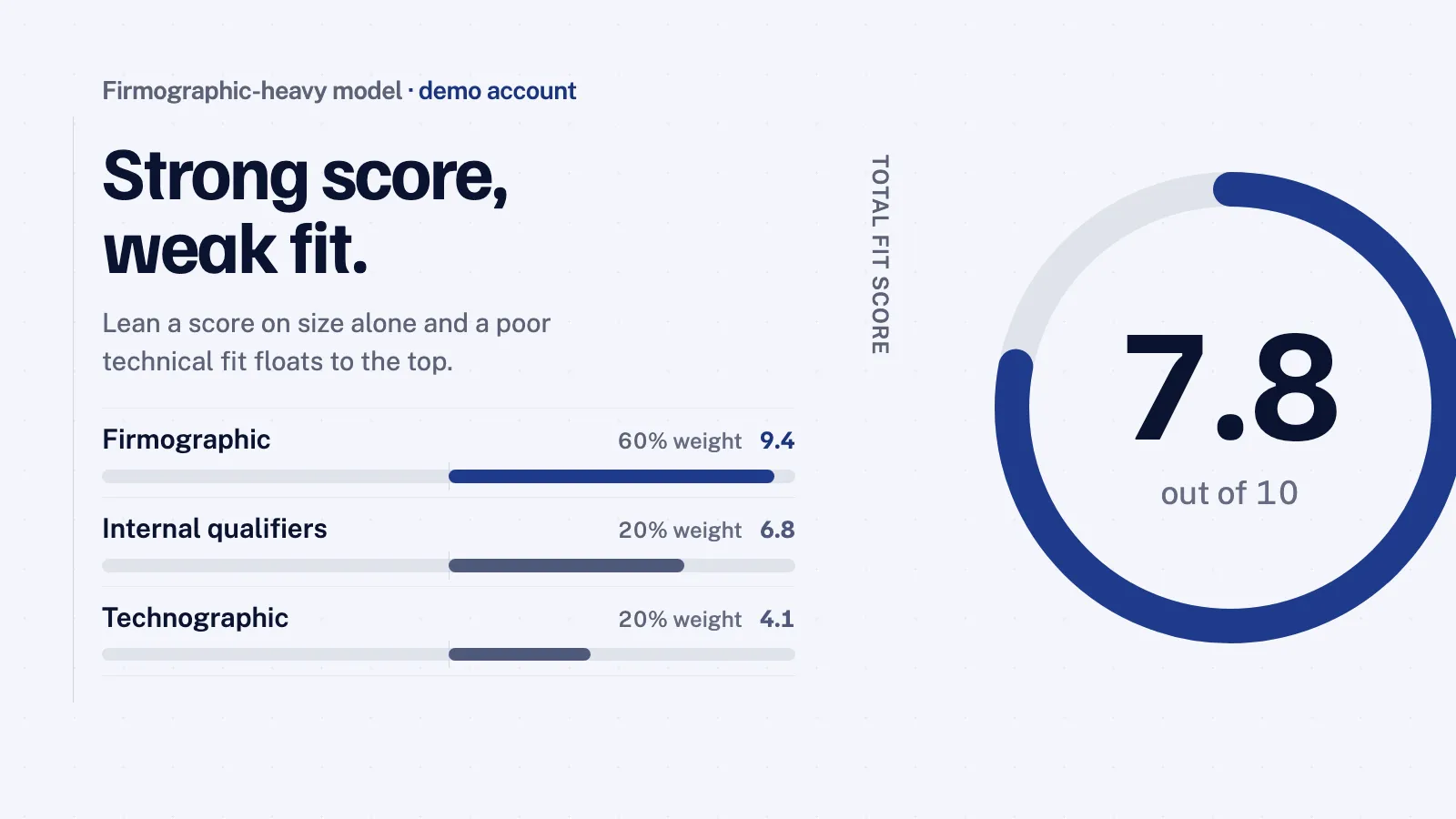
Industry and headcount are only the floor of a fit model. Two companies can look identical on firmographics and be a great fit and a terrible one, and the deeper signals are what tell them apart. Watch what happens when a score leans almost entirely on size.
- Firmographic 60% 9.4
- Technographic 20% 4.1
- Internal qualifiers 20% 6.8
That account reads as a 7.8 on the strength of its size alone. The technographic line, the part that says whether they can actually use you, sits at 4.1 and barely counts. Spread the weight across the factors that predict a good customer, and a big name with a poor technical fit stops floating to the top.
Confusing readiness with fit
A lot of ICPs get muddy because they try to answer two questions at once. Does this account match our ideal, and is it ready to buy right now. Those are different. Fit is about who belongs on the list. Readiness, whether you have the buying group, whether they are showing intent, is about timing. Keep them as separate models you can run side by side, and each one stays legible for what it is.
Never checking whether it works
An ICP is a hypothesis, and most teams never test it. The check is not complicated. Sort your records by the score, and see whether the top band actually connects and converts better than the middle and the bottom. If it does, the model is earning its place. If it does not, the score is calling the wrong records, so you open the breakdowns and re-tune the weights until the ranking matches reality. A model you never validate is just a more organized guess.
Building it in a silo
An ICP that lives in marketing ops, that sales never saw and cannot open, is dead on arrival. The reason scoring beats a document is that the whole team can read the same model and the same reasons on every record. A rep who opens an account and sees a weak signal dragging the score down learns to trust the number, because they watched it reason. That is how a model becomes shared property. And a shared model is one people work, while a private one gets quietly replaced by a spreadsheet on the side.
The through-line
Most of these fixes are the same move: make the ICP something your team can see into and change. A profile nobody can inspect gets ignored and drifts. A transparent, tunable score gets read, questioned, and kept current. If your ICP is broken, a better workshop rarely fixes it. What fixes it is a model anyone on the team can open and follow to the bottom.