ICP scoring: turn your ideal customer profile into a score
An ideal customer profile you can act on is not a slide. It is a score, on every record, that you can read.
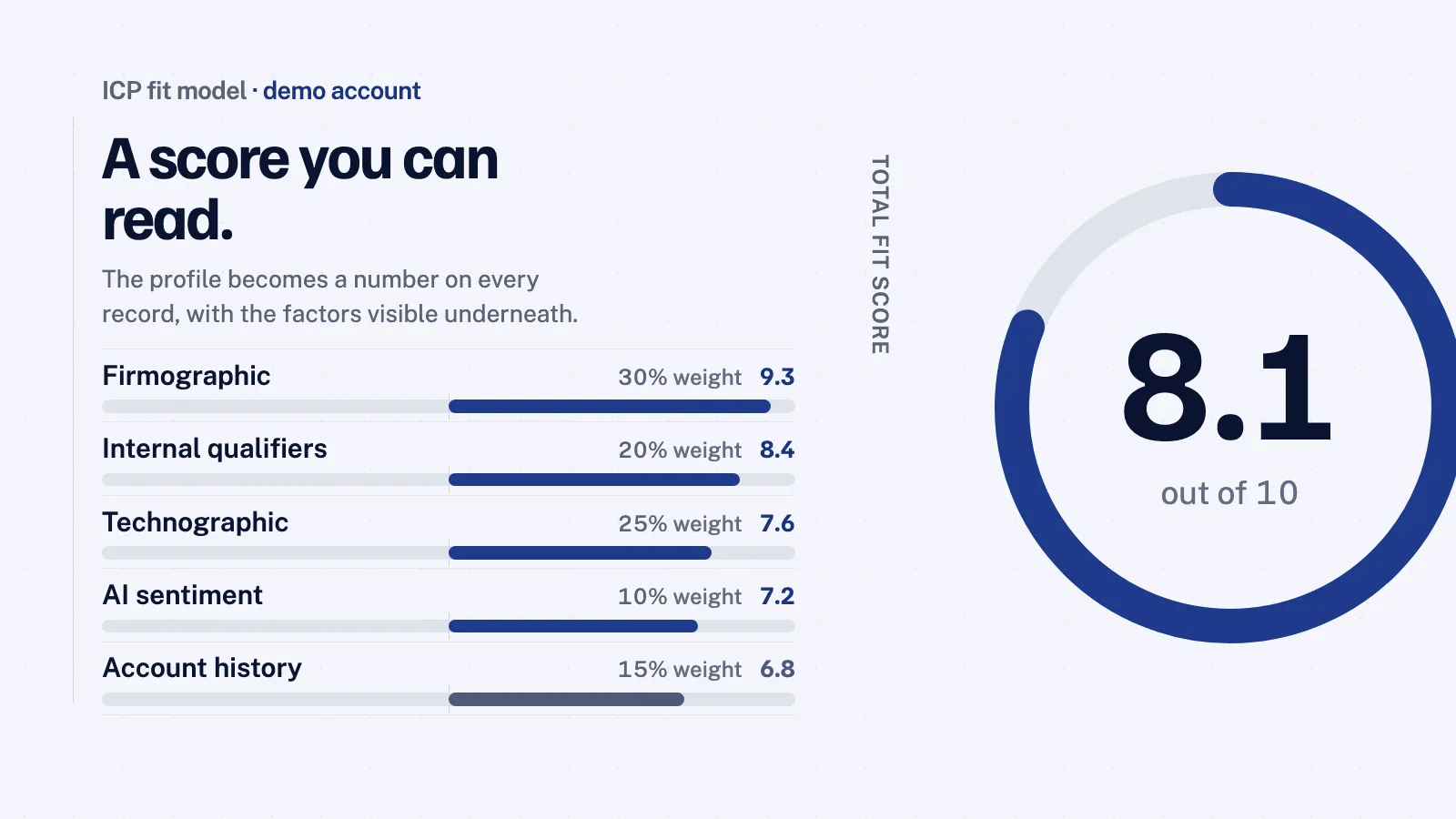
An ideal customer profile is supposed to tell your team who to work. Most of them cannot. They live in a slide deck. ICP scoring turns that profile into a number on every record, built from the things that make an account a fit. A rep opening a lead sees how well it fits, and why.
This is what an ICP is for. Not a definition everyone nods at in a kickoff and then ignores, but a working model that ranks your records and shows its reasons.
What an ICP actually is
An ideal customer profile describes the companies that get the most value from your product and return the most to you. It is more than a list of attributes like industry and headcount. A good one says what makes an account a fit, clearly enough that sales, marketing, and customer success all read it the same way.
A description does not scale. You cannot work a paragraph. ICP scoring fixes that by turning the profile into a model: a set of weighted factors that read your data and produce a fit score on a 0 to 10 scale for every record. The factors stay visible underneath. The profile stops being a document and becomes a column your team can sort.
The factors a fit score is built from
A fit model reads a few groups of signal. These are the ones most B2B teams start with.
Firmographic. The basic shape of the company: industry or sub-vertical, employee count, revenue, region. This is the foundation. If you sell financial software into real estate and finance, a 1,400-person firm in a served region scores high here. A 12-person shop outside your market does not. Firmographic data is stable, so it carries weight but not the whole score.
Technographic. The systems a company already runs, and whether they are ready for you. A team on a legacy system you replace fits better than one that just bought your competitor. If you sell an integration, a company running a dozen disconnected tools is an opening. This is where a fit model separates two firms that look identical on paper.
Internal qualifiers. What you already know from your own CRM: ICP tier, whether it is a named account, whether the region is in target. These are the judgments your team has made, encoded so the score respects them.
Account history. Prior opportunities, past touches, whether the account is already a customer. On a warm list this carries real weight. On a cold list there is little to read, so you weight it low. A missing field adds nothing to the score; it is never counted against the account.
AI sentiment. An optional enriched read on the account from public signals, weighted modestly and only when you have it. It is a property you bring in, not a number the tool invents, so it nudges the score rather than setting it.
There is a separate question people often try to jam into the ICP: how engaged or ready an account is right now. Fit and engagement are different things. The cleaner approach keeps them as separate models you can run side by side. Fit says who belongs on the list. Engagement says who is moving.
“Dynamic” should mean tunable, not self-driving
The pitch you hear is a dynamic ICP that updates itself in real time off market signals. Be careful with that. A score that changes on its own, from inputs you cannot see, is the black box your team already learned to ignore.
What you want is a model you tune. You set the groups and the weights. You can open any record and read why it scored what it did. The score updates as your data updates, hourly by default, or in near real time if your sync runs on webhooks. When your ICP sharpens, you re-open the weights and adjust them by hand. It is dynamic because you keep it that way, not because it quietly retrains itself where no one can see.
A score you can read
The reason to build the ICP as a score, rather than a tier someone assigns by feel, is that a score can show its work.
- Firmographic 30% 9.3
- Technographic 25% 7.6
- Account history 15% 6.8
- Internal qualifiers 20% 8.4
- AI sentiment 10% 7.2
That is the whole argument in one panel. An 8.1 is not a stamp. It is a 9.3 firmographic and 8.4 internal-qualifier fit, a 7.6 technographic read, a lighter 6.8 on history, and a modest 7.2 from sentiment. A rep can see that before the first call and work the account accordingly. When someone asks why this account sits near the top of the list, the answer is on the record, not locked in a workflow two people can open.
Where to start
You do not need a data team to score your ICP. Pick the three to five factors that separate your best customers from your worst. Decide roughly how much each should count. Build the model where your records already live. Read the top and the bottom of the ranked list, and tune the weights until the order matches how your best rep would triage.
Your ICP is only useful if your team believes it. Build it so anyone can open a record and follow the score to the bottom.